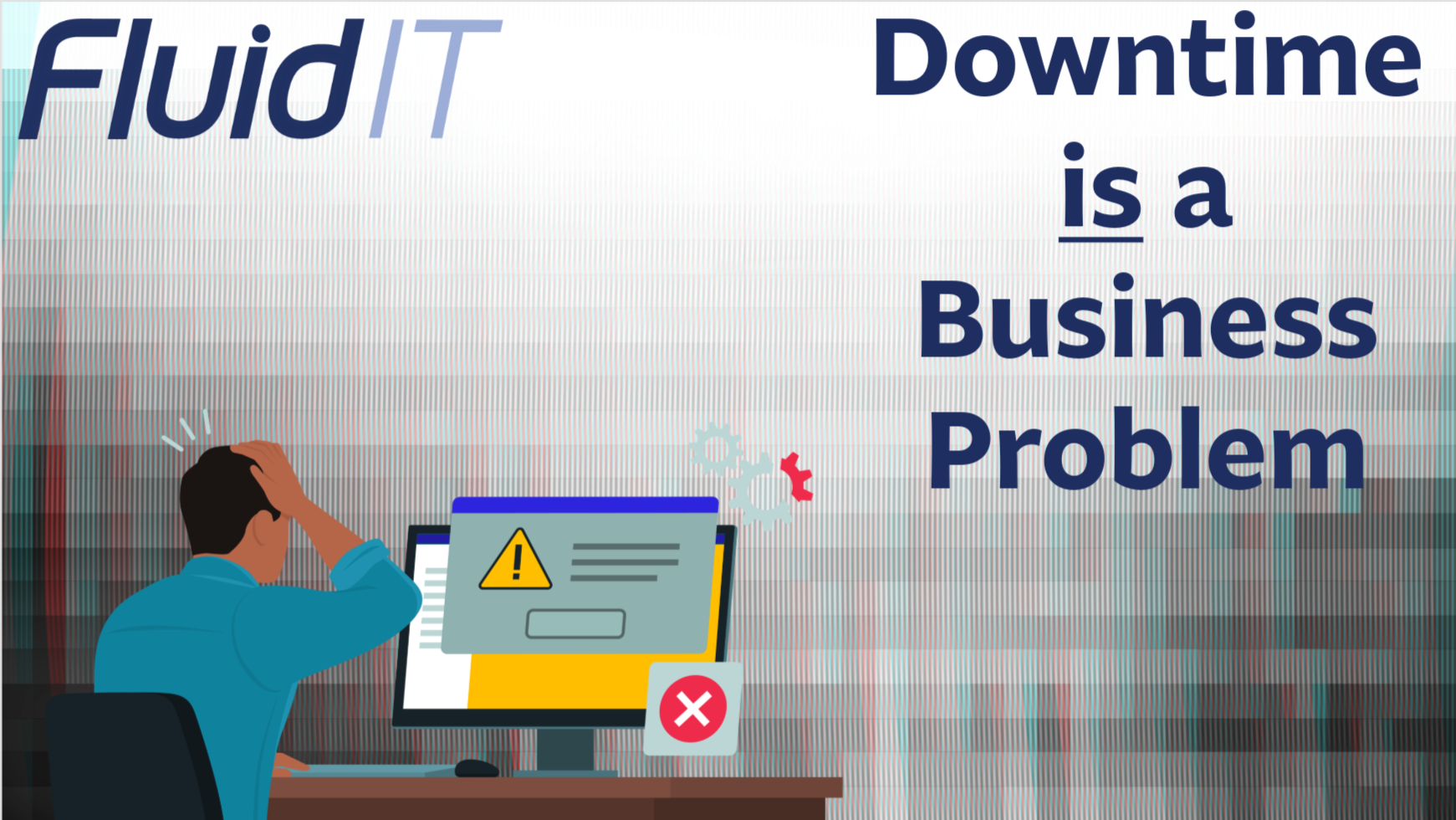
When a system goes down, the immediate conversation is usually technical: what failed, what is the fix, how long will it take. But every minute of downtime is also a business conversation—about revenue not generated, customers not served, employees not able to work, and decisions not made. The disconnect between how IT outages are measured and how they actually affect business operations is one of the most important gaps to close when evaluating your technology strategy. Downtime is not an IT problem that occasionally affects the business. It is a business problem that happens to have an IT origin.
What Downtime Actually Costs
Most organizations significantly underestimate the true cost of downtime because they measure only the most visible component: the direct revenue lost during the outage window. The full cost picture is considerably broader. Employee productivity lost across every affected worker adds up quickly—a two-hour outage affecting twenty people is forty person-hours of lost output, regardless of whether any revenue was directly at risk.
Beyond immediate productivity, outages carry costs that extend past the recovery moment. Customer-facing outages damage trust and retention. Missed deadlines ripple through project timelines. Data entered or transactions processed during the outage window may require manual reconciliation. Leadership time consumed managing the incident and its aftermath represents opportunity cost. And repeated outages create a cumulative perception—internally and externally—that the organization's technology cannot be relied upon.
The Difference Between Recovery Time and Acceptable Downtime
One of the most useful exercises a business can perform is defining, for each critical system, how long it can actually be unavailable before the impact becomes severe. This figure—called the Recovery Time Objective in formal business continuity planning—is often assumed rather than explicitly defined. When it is not defined, IT recovery efforts lack a business-informed target, and the result is recovery that may be technically adequate but commercially insufficient.
An accounting system that can tolerate four hours of downtime during off-peak hours requires a very different recovery architecture than a customer-facing e-commerce platform that cannot afford more than fifteen minutes of unavailability during business hours. Understanding these thresholds is not an IT exercise—it requires input from operations, finance, sales, and leadership. The organizations that do this work before an incident use it to make better investments in resilience. The ones that do not discover the gap during the incident itself.
Prevention Economics vs. Recovery Economics
The economic case for investing in uptime is straightforward but frequently under-argued. Redundant systems, monitoring tools, automated failover mechanisms, and regular maintenance all carry costs that are visible on a budget line. The outages they prevent are invisible—they simply do not happen. This makes proactive resilience investment politically difficult; it is hard to demonstrate the value of problems that did not occur.
Recovery costs, by contrast, arrive without warning and with full visibility. Emergency vendor escalations, after-hours labor, expedited hardware replacement, customer communications, and management time consumed in crisis response all land on the budget at once, typically in a month where the business can least absorb them. The pattern in organizations that track this carefully is consistent: prevention spending is almost always cheaper than recovery spending for the same level of risk.
What High-Availability IT Actually Requires
Building genuine resilience into a technology environment is not a single investment—it is a set of practices applied consistently over time:
- Redundancy for critical systems: Single points of failure in systems that the business cannot operate without should be identified and eliminated. This applies to hardware, internet connectivity, power, and cloud services alike.
- Monitoring with meaningful alerting: Systems should be monitored continuously, with alerting configured to catch degradation before it becomes failure. An alert at 80% disk capacity is far less costly than a crash at 100%.
- Tested recovery procedures: Recovery plans that exist only on paper have unknown effectiveness. Regular testing—simulating failures and practicing recovery—is what transforms a documented plan into a reliable capability.
- Clear escalation paths and communication protocols: When something goes wrong, the time spent determining who is responsible and how to communicate with affected parties adds to the outage duration. These decisions should be made in advance.
Conclusion
Every business has a tolerance for downtime—a threshold beyond which the impact on operations, customers, and reputation becomes unacceptable. Most businesses have not made that threshold explicit, and as a result they have not invested in resilience proportional to the risk. Closing that gap starts with treating downtime not as an IT inconvenience but as a business risk with a measurable cost—and making investment decisions accordingly. The question is not whether you can afford to invest in uptime. It is whether you can afford not to.
 Devin Kindred
 Stephen Casey : Sep 23, 2026, 4:29:59 PM



 Clint Underwood : Mar 5, 2026, 6:00:00 AM